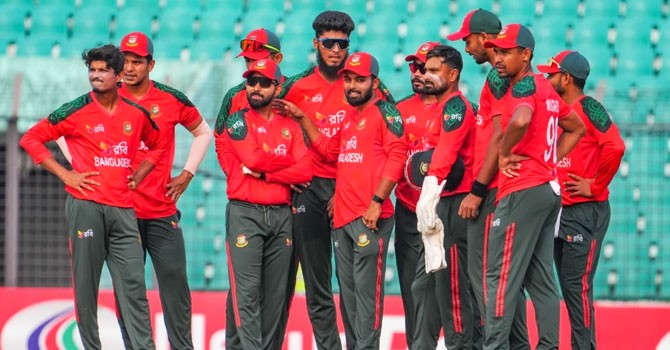
Bangladesh are setting their sights on winning the gold medal in cricket at the upcoming Asian Games, with coach Mohammad Salahuddin confident that both the men’s and women’s teams have the ability to deliver a strong performance.
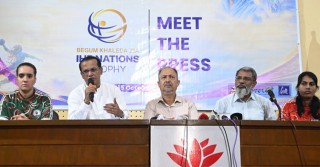
Speaking at a press conference at the Bangladesh Olympic Association building on Monday (September 7), Salahuddin said winning the title is the team’s primary objective.
“We are not thinking about anything other than becoming champions at the Asian Games,” Salahuddin said. “Hopefully, both the men’s and women’s teams will play well and bring good results for the country.”
Cricket was first included in the Asian Games at the 2010 edition in Guangzhou, where Bangladesh won gold in the men’s event. The men’s team later secured bronze medals in 2014 and 2023. The Bangladesh Women’s team won silver in 2010 and 2014 before taking bronze in 2023.
Salahuddin, however, identified adapting quickly to T20 cricket as one of Bangladesh’s biggest challenges. “We have not been playing T20 cricket for quite some time. The biggest challenge will be how quickly we can adapt to T20 cricket and regain our rhythm,” he said.
A total of 10 teams will compete in the men’s cricket tournament. Bangladesh will enter directly in the quarter-finals due to their strong ranking and will play their last-eight match on September 28. Their opponent will be determined after the preliminary round.
A victory in the quarter-final will send Bangladesh into the semi-finals, which are scheduled for October 1.
The tournament will be held at the Ko Rogy Sports Park in the Aichi-Nagoya region of Japan, where a temporary cricket pitch has been prepared by former Bangladesh curator Gamini de Silva. The Sri Lankan-born curator served as the pitch curator at Sher-e-Bangla National Cricket Stadium in Mirpur for around 15 years.
The venue will use a hybrid pitch made with a combination of artificial and natural grass. Asked whether Bangladesh could gain an advantage because of de Silva’s familiarity with the team and local conditions, Salahuddin said the weather and environment would ultimately play a major role.
“Every country has different weather conditions. The actual condition of the wicket will depend on the weather,” he said.